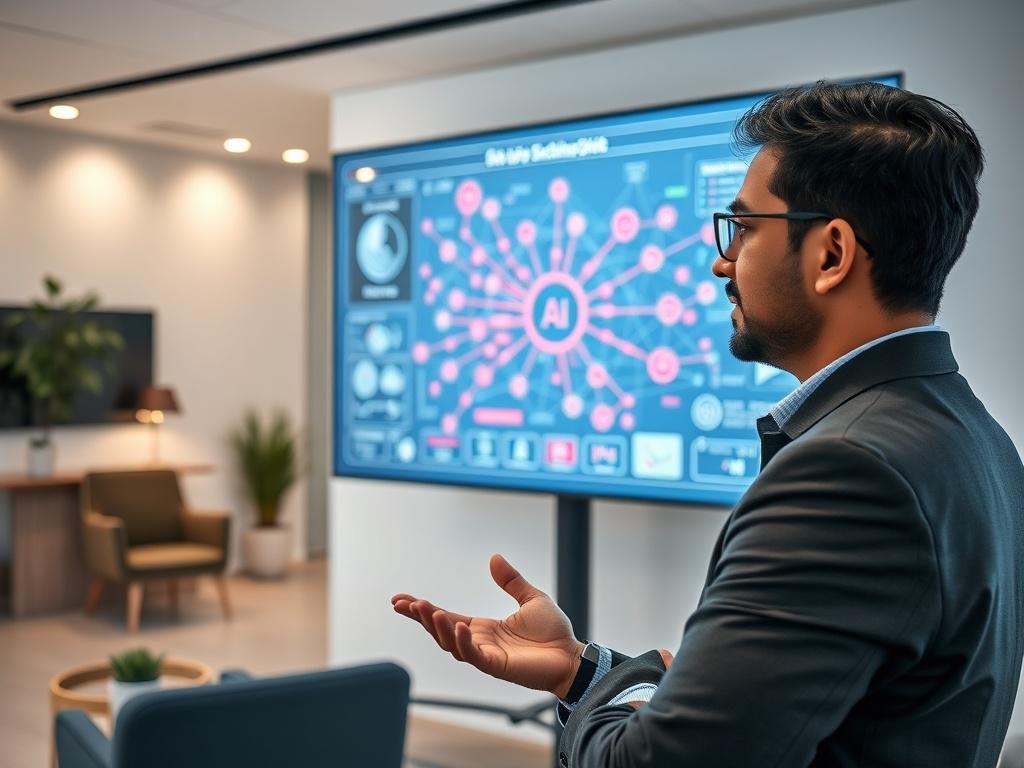
Revolutionizing Enterprise AI: Multi-Agent Systems and Orchestration Consulting
In the rapidly evolving landscape of artificial intelligence, multi-agent systems (MAS) are emerging as a game-changer for businesses seeking to automate complex workflows and enhance decision-making.
These systems involve multiple AI agents working collaboratively, each specialized in a particular task, orchestrated to achieve outcomes that single-agent models simply can't match.
As companies grapple with integrating AI at scale, consulting services focused on multi-agent orchestration are becoming essential.
This blog explores the fundamentals of multi-agent AI, the role of orchestration, and how consulting can guide enterprises through implementation.
Understanding Multi-Agent AI Systems
At its core, a multi-agent AI system is an ecosystem of autonomous agents—software entities equipped with goals, reasoning capabilities, and actions—that collaborate or even compete to solve intricate problems.
Unlike traditional single-model AI, which handles tasks in isolation, multi-agent setups decompose complex processes into specialized roles.
For instance, one agent might handle data retrieval, another natural language processing, and a third decision-making based on insights from the others.
This collaborative approach addresses key limitations of standalone AI, such as hallucinations or limited scope, by enabling agents to share context, verify outputs, and adapt dynamically.
Real-world applications span industries: in e-commerce, agents could coordinate to analyze customer sentiment, fetch product details from internal databases, and search external sources for personalized recommendations.
In finance or healthcare, they might orchestrate compliance checks, risk assessments, and predictive analytics seamlessly.
The shift from single-model automation to orchestrated collaboration promises higher efficiency and innovation, but it requires careful design to ensure alignment and control.
The Power of Orchestration in Multi-Agent Environments
Orchestration acts as the "nervous system" for multi-agent AI, coordinating tasks across agents to enable rule-based workflows, adaptable decision-making, and autonomous reasoning.
Think of it as a supervisor layer that delegates responsibilities, monitors progress, and resolves conflicts. Without effective orchestration, agents might work in silos, leading to inefficiencies or errors.
Platforms like Kore.ai's Agent Platform exemplify this, allowing enterprises to connect, coordinate, and scale AI agents for complex workflows.
Similarly, Kamiwaza AI offers multi-agent orchestration to transform isolated capabilities into coordinated networks, where agents share insights for superior results.
Cognizant's Neuro® AI platform recently enhanced its offerings with multi-agent orchestration, accelerating the journey from AI prototyping to revenue growth by improving decision-making.
Open-source initiatives are also gaining traction. For example, frameworks like CrewAI and LangChain facilitate orchestration by managing workflows among specialized agents, ensuring seamless collaboration.
Clearwater Analytics' CWIC Flow represents a pioneering multi-agent system that integrates tools for data access, memory, and skills, moving beyond simple chatbots to deliver contextual insights.
The Role of Consulting in Multi-Agent AI Adoption
Implementing multi-agent AI isn't plug-and-play; it demands expertise in architecture, security, governance, and integration. This is where orchestration consulting comes in—specialized services that help enterprises design, deploy, and optimize these systems.
Consultants assess business needs, recommend frameworks (e.g., Model Context Protocol for workflow automation), and ensure scalability across clouds or models.
They address challenges like debugging multi-agent interactions, as highlighted in community discussions on open-source orchestration engines. For enterprises, this means faster AI adoption with built-in observability and compliance, turning AI from a productivity tool into a growth driver.
Key benefits of consulting include:
- Customized Architectures: Tailoring agent hierarchies to specific use cases, such as supply chain optimization or customer service automation.
- Security and Governance: Implementing models to safeguard data and ensure ethical AI practices.
- Real-World Implementation: Drawing from examples like IBM's orchestrator agents for continuous learning and adaptation.
Challenges and Future Outlook
Despite the promise, multi-agent orchestration faces hurdles like coordinating at scale, managing agent conflicts, and integrating with legacy systems. Consulting firms mitigate these by providing strategic roadmaps and leveraging emerging tools.
Looking ahead, as AI agents become more autonomous, orchestration will evolve with advancements in distributed data engines and locality-aware services. Enterprises that invest in consulting now will lead in AI-driven innovation, potentially unlocking new revenue streams through enhanced efficiency and intelligence.
In summary, multi-agent AI and orchestration represent the future of enterprise automation. With expert consulting, businesses can harness this technology to stay competitive in an AI-first world.
If you're exploring implementation, consider platforms like those from Cognizant or Kore.ai as starting points. Stay tuned for more deep dives into AI trends!
REQUEST WHITEPAPER
SCHEDULE A DEMO & RFP
GET ME 30 MINUTES DISCOVERY CALL